Blocks and themes
How a Quoin site is built from a library of blocks, and why the design can change without touching the content.
Built from blocks
Every Quoin page is either a document written in Markdown, or a list of blocks: a hero, a section of text, a grid of cards, a gallery. Each block has a strict schema. A person or an agent can only compose pages from pieces the site knows how to draw, and each piece must carry every field it needs.
The library below is not typed by hand. It is read from the active theme’s manifest when the site is built, so it cannot fall out of date.
The block library
Every block the active theme can render.
beta-progressHow many places in the current beta phase are taken, counted from the beta records when the site is built.
block-libraryThis list: the blocks the active theme can render, read from its manifest when the site is built.
card-gridA grid of linked cards, each with a title and a short summary.
definitionA dictionary-style entry: a word, how to say it, and what it means.
featureSpotlights one page, pulling its title and summary from the page itself.
galleryA sequence of images. Alt text is required, so every image is described.
heroThe opening banner: a headline, a short introduction, an image and up to two buttons.
link-listA curated list of links, each with an optional note.
loop-stepsA process shown as numbered steps across lanes for who does what, with an optional loop back.
noticeA highlighted box for something readers must not miss.
textA section of prose with an optional heading.
Swap the theme, keep the content
A theme draws everything you see: the header and footer, a renderer for each block, a template for each kind of page, and the styles. Content never contains layout. So changing theme is one line in the site’s configuration, and the content stays exactly as it was.
Quoin’s tools check the content against every installed theme. A theme that cannot draw a block the content uses is refused loudly, rather than quietly breaking a page.
Same content, two themes
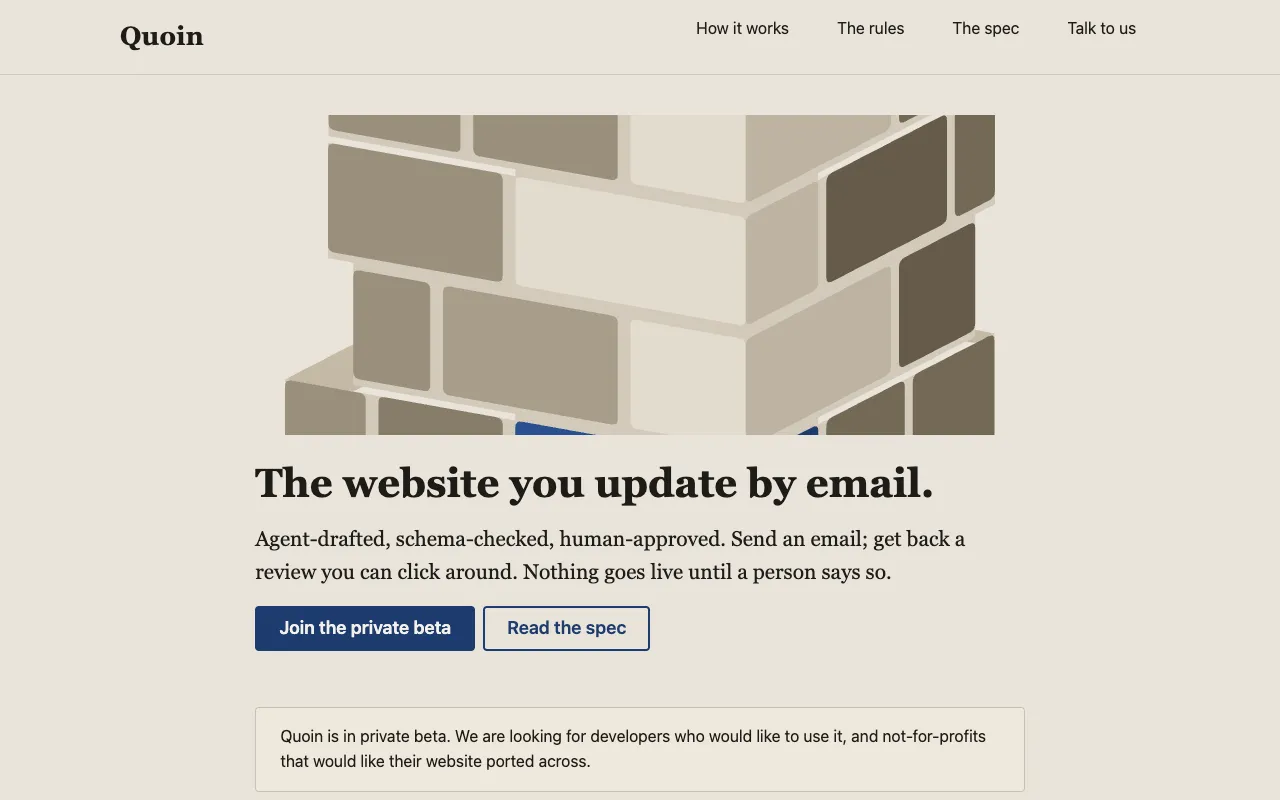
The same home page in the plain base theme, captured on 24 September 2026. 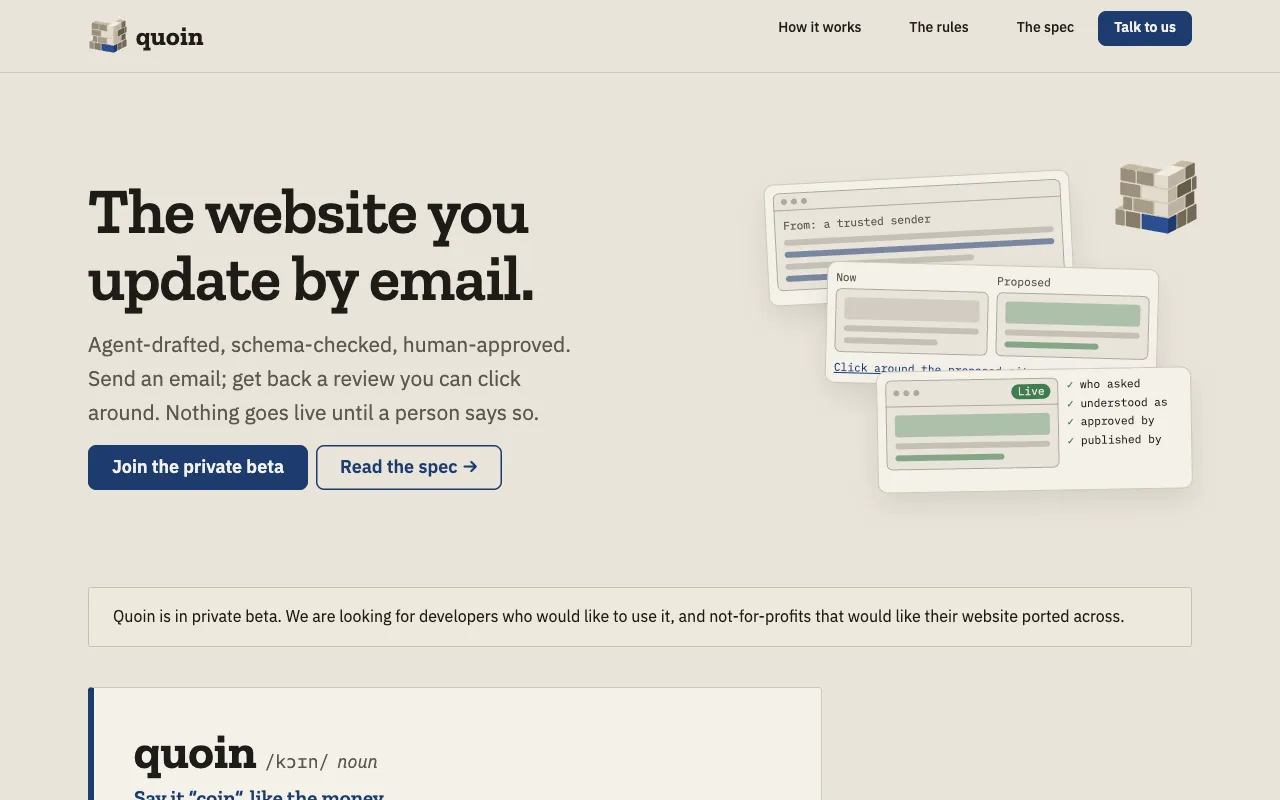
The same content in the cornerstone theme you are reading now.
The freedom that gives you
Redesign without rewriting. A new look is a new theme, built and previewed on its own branch while the live site carries on. Pages written years ago render in next year’s design.
One family, many faces. A campaign group and a parish council can share the same blocks and still look like themselves.
Agents stay out of the design. They write content through tools that refuse layout, unknown fields and structural files. Design changes are code, reviewed like code.
- Browse the living component library — Every block and piece of chrome, drawn by the active theme.
- Read the theme contract — How themes, manifests and swapping work, in the specification.